
The Cost of Community
How America’s Fight for Community Perpetuates a Cycle of Displacement
Written by Mack Lieberman & Graham Glaab
On an average day in 2024, 70% of Americans did not engage in any socializing or face-to-face communication — up from 62% in 2014 and 52% in 2003. Among those who did socialize, time spent dropped from 43 minutes per day to 35 minutes. The U.S. Surgeon General has now declared our country in the midst of a "loneliness epidemic.” There are many factors contributing to this loneliness, but something rarely considered is the impact of our built environment. Young Americans are desperate to live in places that actively encourage community, and the few places that do will become the defining lifestyle over the coming decades.
In past societies, housing was built near workplaces, places of leisure, and shops, because walking was the only mode of transportation. But slowly, that changed. The popularization of steam engines and trolleys allowed only the wealthy to live in suburbs, but the automobile changed everything. Mass production techniques created an affordable option for the average American, and suddenly, there was no incentive to live near workplaces, leisure spots, or shops. Instead, you could simply drive 20 minutes to get where you needed to be. As the suburbs spread into the countryside, large highways were built to accommodate the increased traffic.
In fact, the Federal-Aid Highway Act of 1956 authorized the construction of over 40,000 miles of highway. Middle-class Americans, typically White, became wealthy enough to buy automobiles. This led to the use of these new highways to access cheap land that surrounded cities. Thus, the idea of an affordable single-family home emerged. Through programs like the G.I. Bill, the National Housing Acts, and racist redlining policies, neighborhoods of exclusively single-family homes went from being reserved for the wealthy to becoming the norm for White, middle-class families.
Americans and their housing are taking up exponentially more space today than they did in the past. Today, around 75% of land in cities is zoned exclusively for single-family homes, and since the 1970s, the average square footage per person in a U.S. home has almost doubled.
The State of Suburbia Today
Numerous scholars, most notably Robert Putnam, have critiqued the negative social effects of American suburban sprawl. Today, experts are finding that suburban living in America has numerous detrimental side effects. To list a few, residents of suburban sprawl are more likely to:
American suburbs lack communal gathering places such as local stores, parks, restaurants, and other third places. Instead, they force residents to drive outside their neighborhood for basic needs, depriving them of almost all opportunities for social interaction.
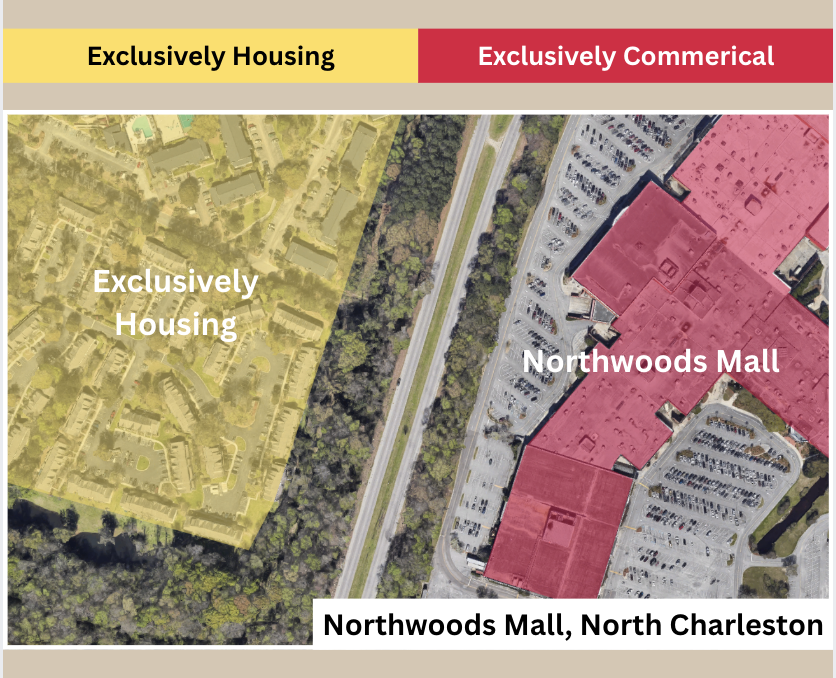
Single-use zoning physically separates residential areas from the places where community is built and social life happens (malls, restaurants, parks, etc).
Suburban homes are also physically isolated from one another by large yards and fences, and, when combined with the need to leave the neighborhood for resources, natural interaction with neighbors is scarce. Furthermore, suburban infrastructure often costs substantially more than the tax revenue it generates. For example, 100 people in a suburban community will require many times as many sewer pipes, electrical wiring, sidewalks, roads, traffic lights, etc, as the same 100 people living in higher-density areas.
Lower-density suburban sprawl comes at a financial cost, requiring substantially more square footage of infrastructure per capita than tax revenue can cover. Oftentimes, this causes high-density urban areas to effectively subsidize suburban areas with their excess tax revenue.
Taken together, these factors discourage social interaction, exercise, and community in American suburbs. This phenomenon is becoming widely accepted by the American public. Therefore, places that encourage community and health are becoming increasingly valuable.
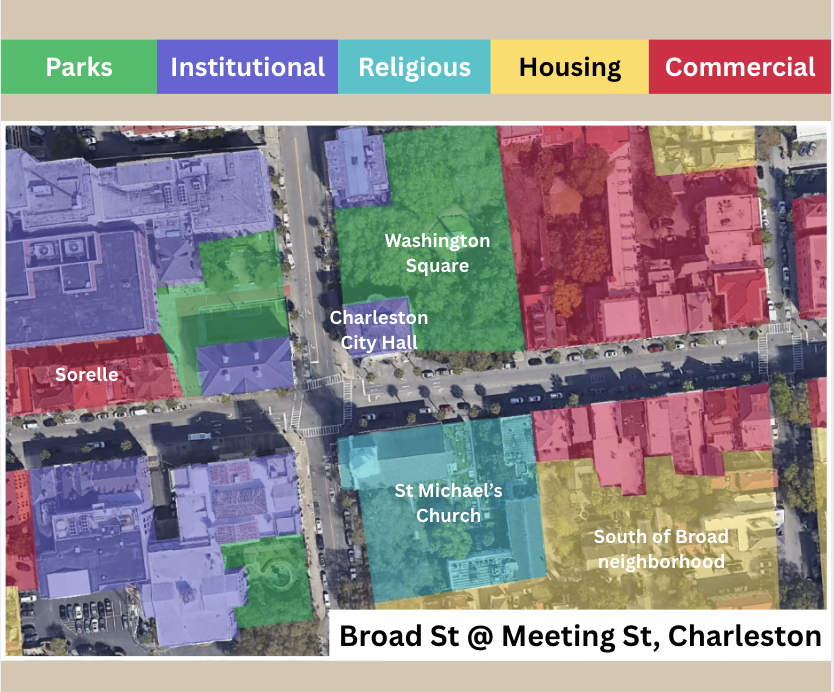
For example, take historic downtown Charleston. Mixed-use areas like this one allow homes, apartments, cafes, and businesses to coexist, encouraging social interaction and community identity.
Without policy reform, however, the increased desire for communal urban spaces will negatively affect those who cannot afford them. Long-time residents, often historically Black communities, are in the midst of a national displacement from urban neighborhoods. Leftover segregation-era zoning practices are unfairly treating the residents who currently reside in these now sought-after places. We must ensure a future in which we can create more community, and not just fight over what is left of it.
Gentrification & Displacement in Charleston
In countless places, cities historically worked to systematically disenfranchise Black communities, leaving them vulnerable to displacement today. These were intentional acts by city governments and carried out in accordance with “law and policy,” and Charleston is no exception. Because walkable areas are seldom built today, historic cores like Charleston have incredibly high market demand, driving up property values and, in turn, creating displacement.
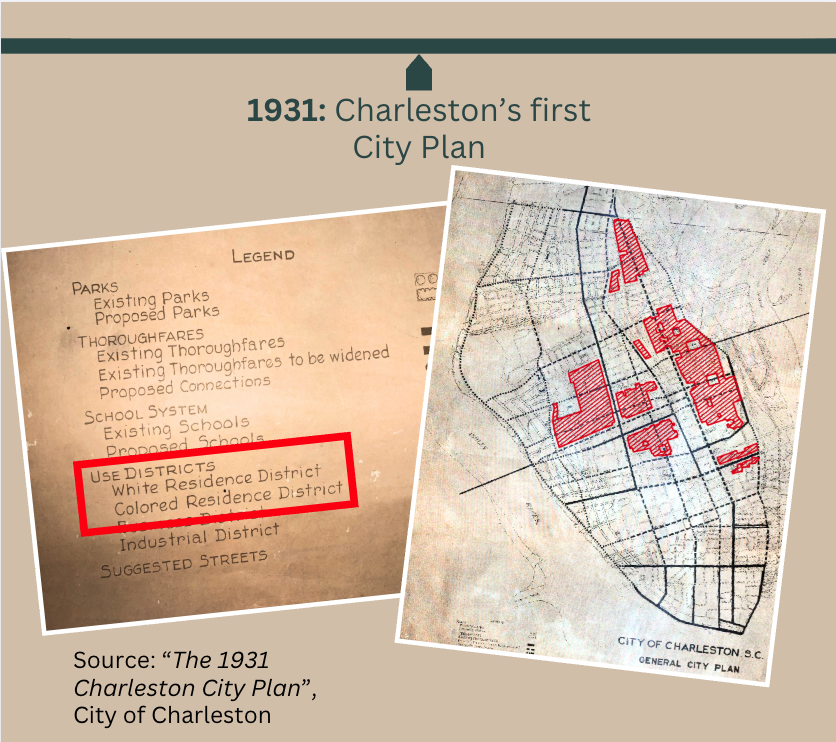
Charleston’s first-ever zoning code (1931 Charleston City Plan) had racially restrictive zoning that standardized segregation further and legally encoded it by neighborhood.
During the rise of urban renewal, city officials targeted historically Black neighborhoods, labeling them as ‘slums’ to target them with slum clearance projects, only for them to be replaced with even worse public housing projects, which the city refused to invest in.
Many of these housing complexes (Gadsden Green, Gadsdenboro, Cooper River Courts) are now sites of intense wealth inequality, where housing was demolished to make way for luxury housing (Gadsdenboro) or luxury housing was built adjacent to public housing (Gadsden Green/Westedge).
This follows national trends of slum clearance and urban renewal, which led to mass destruction in other cities, such as Boston’s West End.
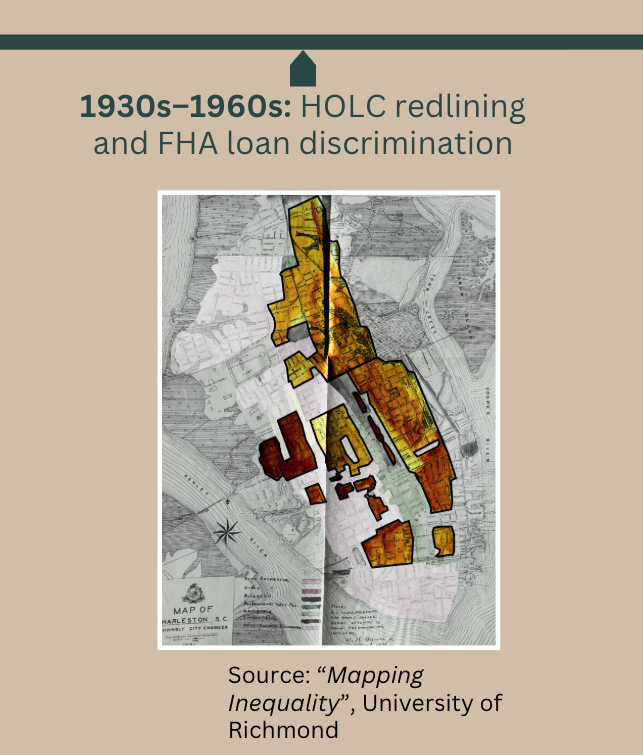
The federal government drew ‘redlining maps’ all across the United States, which determined where federal home loans could go. In Charleston, historically Black neighborhoods were designated as ‘blighted’ so they could not receive those home loans.
This systemically pushed home loans, and thus homeownership, out of reach for many historically Black communities.
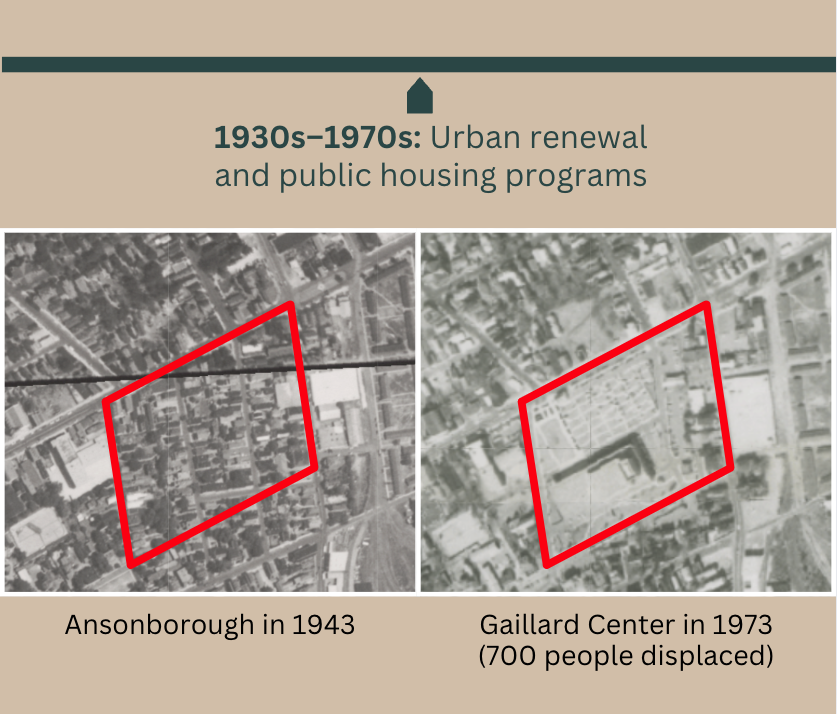
During the era of slum clearance and urban renewal, city officials specifically targeted historically Black neighborhoods for clearance, often against the wishes of residents, for those neighborhoods to be replaced with public works projects and segregated public housing.
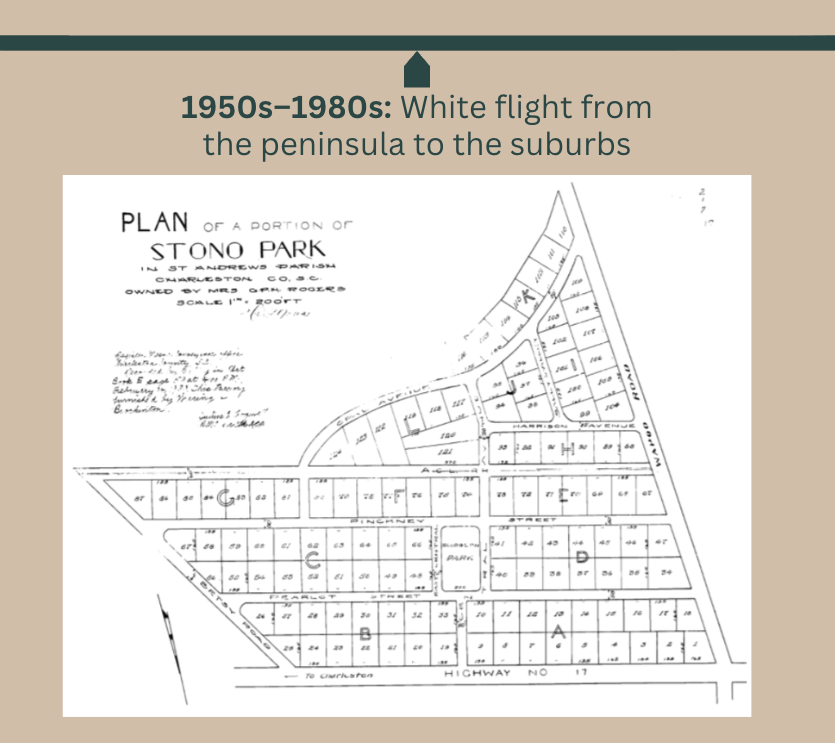
With the rise of suburban sprawl, many White communities moved en masse to suburbs like West Ashley and James Island, but kept historically Black communities out of these neighborhoods with racial covenants and other discriminatory practices. Historically Black communities were systematically cut off from homeownership in the suburbs for decades.
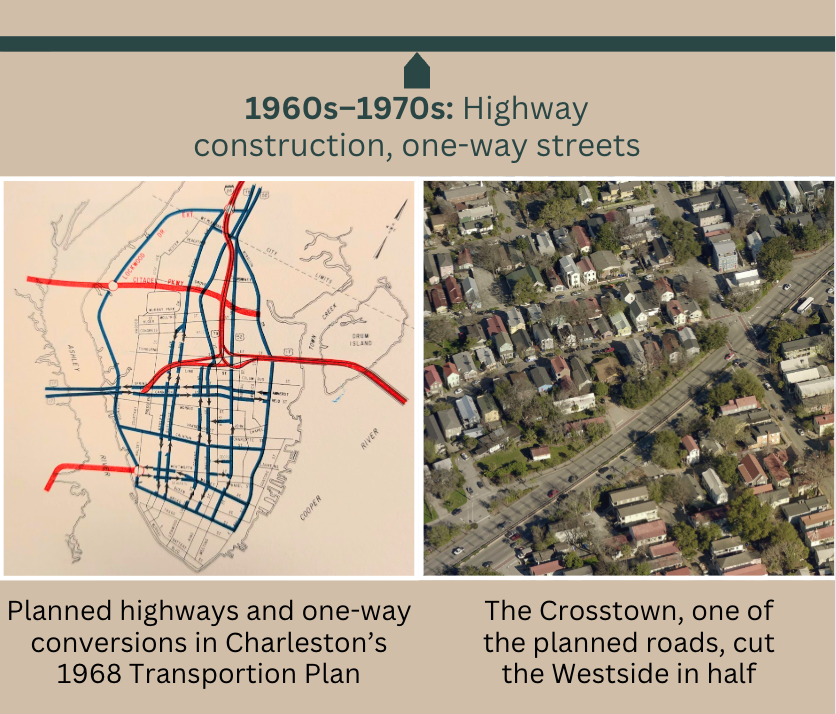
Downtown policy was reshaped around the interests of White suburbanites, even though they no longer lived downtown. New plans and projects were designed to move suburban car drivers around downtown, mostly at the expense of peninsula residents who lived near these roadways.
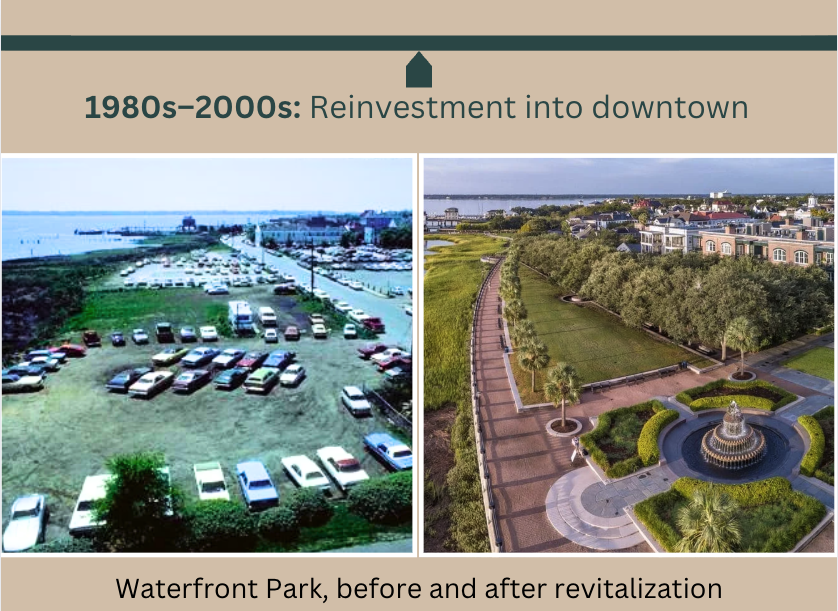
Under the guidance of Mayor Joe Riley and preservation groups, the City government changed pace and started to reinvest in downtown. Highway projects stopped; neighborhoods were rehabilitated instead of demolished; new investments were made into King Street; Waterfront Park was built. Tourism also became a key focus of revitalization.
Moving Forward…
Supporting mixed-use development will allow people of all economic backgrounds to have communities where they can shop, eat, and socialize. The era of the automobile brought a single-family home to those fortunate enough, but we have now learned that a suburban lifestyle is unhealthy.
As demand for walkable urban neighborhoods increases, so will the price. As a result, lower-income and historically Black residents will be priced out and displaced into automobile-dependent suburbs, the same places they were excluded from decades ago. We must ensure we change our building practices rather than perpetuate a cycle of displacement. Historically Black communities were left behind for suburban growth, and now that they have been deemed undesirable, these same communities are being forced to live in them.
It is time to revamp the foundations of American laws and zoning codes. Legalizing mixed-use and mixed-density housing will expand the overall housing supply in a single area. This will prevent lower-income residents from being priced out, while still giving everyone access to community, walkability, and health.
A common fallacy is that new development causes gentrification. In reality, displacement is fundamentally a supply-and-demand issue. When housing supply falls short of demand, housing becomes more expensive, increasing the risk of displacement. Enabling mixed-use and mixed-density housing relieves financial pressure on historic communities. At its core, gentrification is just the improvement of a neighborhood with nicer buildings, stores, and restaurants. Our policies fail to allow for lower-budget buildings, stores, and restaurants to coexist. If we reform our policies correctly, gentrification will not be associated with displacement, and every community will be able to coexist without a housing supply issue.
It is also important to note that mixed-use development does not always mean high-density development. Many of our featured examples highlight downtown Charleston because it is recognizable and popular, but these principles apply at every scale. Lower-density suburban areas should still absolutely be built, but we simply argue that they should be more human.
For further information on these topics, we recommend checking out the New Urbanist Movement, the book Life After Cars, and our Resources page.
